
Game On: The World Cup is a Prime Gen Z Acquisition Opportunity
Prefer to listen? Hear our take on why the FIFA World Cup 2026™ is a prime Gen Z acquisition opportunity for financial brands:
The FIFA World Cup 2026™ is here- and the world is watching. Billions of fans. One hundred and four matches. Sixteen host cities across three countries. The scale is staggering, and cultural energy is incredible.
For financial marketers, that energy translates directly into opportunity. This tournament is generating massive brand investment from fast-casual food chains to sportswear giants — but the real story isn’t in the sponsorship dollars. It’s who’s watching, and what they’re ready to spend.
The World Cup presents a rare, time-limited acquisition window to reach Gen Z and millennials — two cohorts that tend to tune out traditional financial advertising — at a moment when they’re culturally engaged, emotionally open, and already in an active spending mindset. Here’s how to make the most of it.
The Audience Demographics Make This Tournament Different
Not all major sporting events attract the same viewers. The Super Bowl skews older segments. March Madness is geographically concentrated. The World Cup is an outlier, appealing to a vast audience from all demographics and geographical areas. Today, we’ll focus on the US audience.
According to Numerator, roughly 32% of U.S. consumers plan to watch at least one match, up from 26% in a January 2026 survey. More importantly, the World Cup over-indexes significantly with younger audiences: approximately 40% of Gen Zer’s and 39% of millennials plan to tune in.
This is precisely the audience many financial brands have struggled to reach through conventional channels. Gen Z, in particular, presents a notoriously challenging acquisition target. As discussed in Media Logic’s analysis of credit card acquisition trends, this cohort largely searches for financial products based on rate messaging rather than rewards, and FIs are increasingly turning to creator partnerships on TikTok and YouTube to generate financial education content and brand awareness among first-time cardholders. World Cup viewership creates a complementary, high-reach environment to support those efforts.
Higher Viewership Intent, Higher Spend Intent
The audience’s composition alone would make the World Cup noteworthy. Combine it with spending intent, and the opportunity sharpens considerably.
EMARKETER reports that nearly 89% of World Cup viewers expect to make a purchase related to the event – outpacing both the Super Bowl (88%) and Winter Olympics (71%). Average expected spend of $74 also tops both competing events ($68 for the Super Bowl, $63 for the Winter Olympics). In aggregate, those dynamics could generate roughly $7.5 billion in consumer spending in the U.S. alone, excluding in-person attendee purchases — topping the Winter Olympics ($7.2 billion) but trailing the Super Bowl ($11.5 billion).
These consumers are actively spending on food, merchandise, travel, and experiences. And they’re using your payment products to do it.
Opportunity Areas for Financial Marketers
The World Cup spend environment creates natural, contextually relevant entry points for financial brands. Especially through the following products that align to the occasion:
- Travel rewards cards. International visitors are spending roughly 1.7x more than the typical traveler, per the U.S. Travel Association. Travel-focused card promotions that emphasize no foreign transaction fees, elevated travel rewards categories, or trip protection benefits can speak directly to consumers watching from abroad or planning tournament travel.
- Example: In February 2026, Capital One launched a limited-time “Venture X VIP Access” promotion offering Venture X cardholders exclusive access to World Cup tickets – plus a double miles bonus on all travel bookings through Dec 18th.
- Rewards tie-ins and limited time offers. Spend-based bonuses tied to dining, streaming, or retail categories align naturally to how consumers are engaging with the tournament. Issuers with flexible rewards structures should consider whether promotional offers can be anchored to the cultural moment.
- Example: American Express is currently running a Shop Small offer highlighting cardmember discounts at soccer specialty retailers nationwide, while Chase Freedom Flex offered a one-time 10% cash back bonus (up to $25) on select streaming service subscriptions during the World Cup window.
- Digital wallet and BNPL visibility. Gen Z is a mobile-first payment audience: recent findings show that 67.1% of Gen Z mobile users will be proximity mobile payment users by 2027. Fintech brands and challenger banks already embedded in digital wallets have an opportunity to reinforce their presence as spending activity ramps up.
- Example: Klarna is offering users a $5 credit for every $50 spent through the Klarna app at participating merchants during the World Cup tournament. Affirm is running a similar $10 off promotion, while UK-based Revolut pushed in-app discounts at pub and restaurant partners showing live World Cup matches.
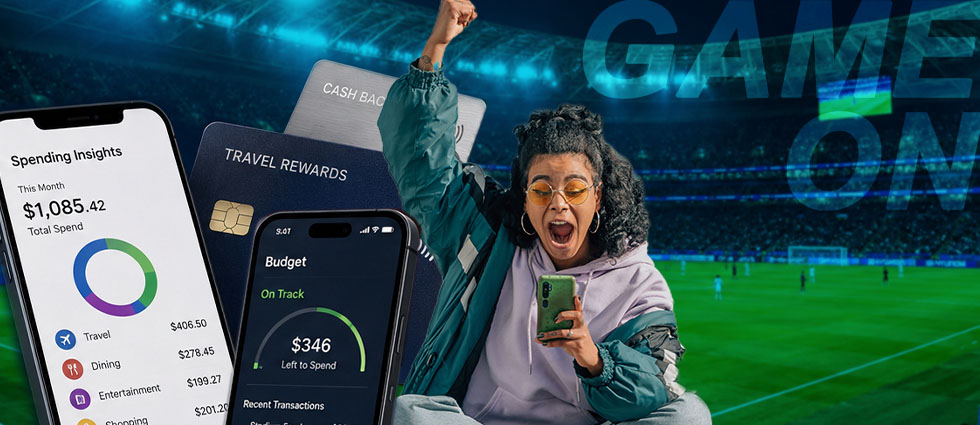
- Financial wellness and spend-tracking tools. Gen Z cardholders over-index in their desire for payment flexibility with 47.7% stating they want more control over their payments. Brands that surface spending insights, budgeting tools, or payment control features during a high-spend event can demonstrate concrete product value precisely when it’s most relevant.
- Some of the Top Spend-Tracking & Financial Tools include:
| Tool | Key Gen Z Appeal |
| Cleo | Gamified budgeting, AI chatbot, and cash advance up to $250 |
| Monarch Money | Collaborative features for splitting costs |
| Rocket Money | Subscription detection, spending alerts, bill negotiation |
| WalletHub | Financial “score,” spending trimmer, peer comparison |
| PocketGuard | Simple real-time “safe to spend” number |
| Firstcard | Combines credit building with spend tracking |
| Source: Financial Fitness Passport |
Note: All of these fintech tools connect directly to bank accounts and credit cards, automatically categorizing transactions and showing spending insights through visual reports — eliminating the manual effort of tracking every expense
Key Takeaway: The brands best positioned to capitalize are those that are currently aligning their messaging to the mindset of a younger consumer who’s already engaged, already spending, and [critically] still forming their financial brand preferences.
The Acquisition Logic: Impressions Now, Decisions Later
There’s a temptation in financial services marketing to focus activation around immediate conversion — a card application, an account opening, a direct response. That’s the right lens for much of what we do. But the World Cup opportunity operates on a slightly different timeline.
Gen Z consumers are still in early stages of building their financial relationships. Research from Mastercard highlights that this cohort switches financial institutions two to three times more often than their parents, and four times more often than their grandparents. Brand impressions made now (especially those rooted in cultural relevance and genuine product utility) translate into consideration the next time those consumers are ready to make a decision.
This is the same logic that makes direct mail effective even when it doesn’t prompt an immediate response. The impression lands; the relevance is felt; the conversion follows when the timing is right. World Cup-aligned financial marketing follows a similar logic, particularly when supported by an omnichannel strategy that keeps the brand visible across digital, social, and physical touchpoints throughout the tournament window.
The Economic Impact Remains Massive
It’s worth noting that the World Cup’s originally projected economic impact (FIFA estimated a $30.5 billion boost) looks more optimistic than actual conditions support, with high travel costs and geopolitical headwinds tempering some demand. But for financial marketers, that context is largely beside the point. The audience’s opportunity doesn’t hinge on total economic output; it hinges on who’s watching, how engaged they are, and what they’re inclined to spend.
As EMARKETER puts it plainly: “few global events command this level of attention, [so] sitting on the sidelines isn’t really an option.” For financial brands trying to build relationships with younger consumers, a mass cultural moment that disproportionately attracts Gen Z viewers (aka consumers who are spending, engaged, and forming long-term brand preferences) is exactly the kind of contextual window that a well-designed acquisition strategy should target.